My Cat Drank So Little Water That the Vet Handed Me a $900 Estimate for Kidney Workup — Here's What Finally Got Her to Drink
The vet put the bloodwork results on the table and pointed to one number. "Her urine specific gravity is 1.062," she said. "That's borderline. She's chronically dehydrated. We need to talk about her water intake."
I looked at my tabby, Mochi, sitting in her carrier looking perfectly fine. She was eating normally. Playing with her feather wand. Using the litter box. How could she be dehydrated?
Then I thought about it. I filled her water bowl every morning. I cleaned it every other day. I put it right next to her food bowl — convenient, right?
And I realized: I almost never actually saw her drink from it.
That was the beginning of a three-month journey that involved four different water bowls, two fountains, a spreadsheet (yes, really), and one very expensive lesson about how cats and water just don't mix the way we think they do.
If your cat treats their water bowl like it's filled with poison, you're not alone. Here's what I learned — and what finally worked.
Why Cats Are Terrible at Staying Hydrated
Here's the thing that blew my mind: domestic cats are descended from African wildcats that lived in desert environments. For thousands of years, their ancestors got most of their water from prey — a mouse is about 70% water. They never evolved a strong thirst drive because they didn't need one.
The problem is, we feed our indoor cats dry kibble, which is about 10% moisture. Then we put out a bowl of still water and expect them to make up the difference. But their biology is still running on desert-animal software. They don't feel thirsty until they're already significantly dehydrated.
And chronic low-grade dehydration isn't just "kind of bad." It's directly linked to:
- Kidney disease. This is the big one. According to a study published in the Journal of Feline Medicine and Surgery, chronic kidney disease affects 30-40% of cats over 10 years old, and chronic dehydration is one of the biggest contributing factors.
- Urinary crystals and blockages. Especially in male cats, where a blockage can be fatal within 24-48 hours. Low water intake means concentrated urine, which means crystals form more easily.
- Constipation. The colon pulls water from stool. Not enough water in the system = hard, painful stools.
- Lethargy and poor coat quality. Dehydrated cats often look dull and tired before they show any "obvious" symptoms.
The scary part? Cats hide dehydration really well. By the time you notice something's off — they're not eating, they're hiding, they're lethargic — they might already need IV fluids at the emergency vet.
The Stuff I Tried That Mochi Completely Ignored
Before I figured out what worked, I burned through the obvious solutions:
A bigger bowl. "Maybe she doesn't like the small bowl?" Bought a wide, shallow ceramic bowl. Mochi sniffed it once and never touched it again.
Fresh water twice a day. I became obsessive about changing the water. Morning refill, evening refill. She didn't care.
Moving the bowl away from her food. Some sources say cats instinctively avoid water near their food because in the wild, a dead prey animal near water = contaminated water. Made sense. Moved the bowl to the hallway. Zero change.
Ice cubes. "Cats are curious about ice cubes!" I read on three different blogs. Mochi watched an ice cube melt with the detached interest of someone watching paint dry, then walked away.
A cat water fountain (the cheap one). I bought a $25 fountain on Amazon with a little flower on top. The motor was loud. Mochi wouldn't go near it. The water got slimy within 48 hours. I threw it away after two weeks.
At this point, I'd spent about $60 and accomplished exactly nothing. Mochi was still dehydrated, and my vet was still giving me that "I'm concerned but trying not to alarm you" look.
What Actually Got Her Drinking: The Five Things That Worked
1. The Right Fountain (and It Cost More Than the Cheap One for a Reason)
I gave up on fountains for a while after the flower disaster. Then a friend who runs a cat rescue told me the problem wasn't fountains — it was that fountain. "Cats prefer fountains with a wide, flat drinking surface," she said. "Not a trickle they have to catch mid-air."
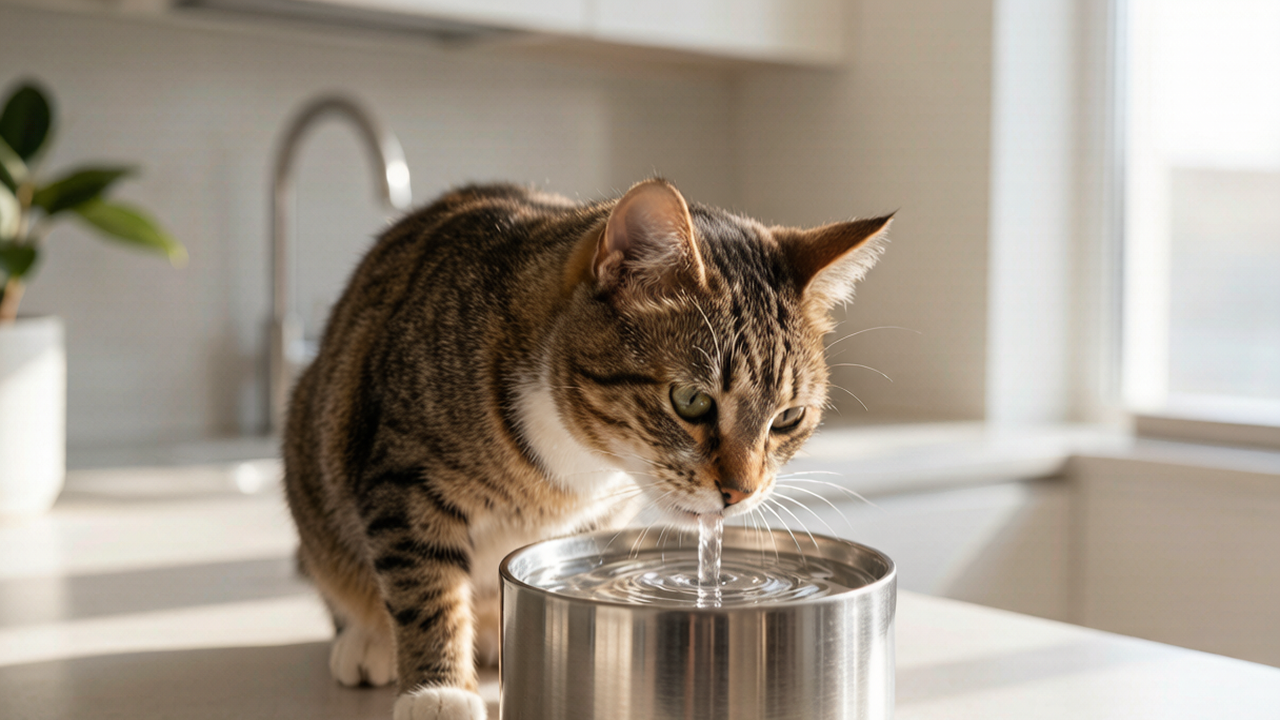
I bought a stainless steel fountain with a shallow, free-falling stream and a large drinking basin (the Pioneer Pet Raindrop, about $40). The stainless steel matters — it doesn't harbor bacteria like plastic, and it doesn't develop that slimy biofilm as fast. The motor was nearly silent.
I set it up in the living room, not the kitchen. (Turns out, cats prefer drinking in rooms where they feel safe and relaxed — not high-traffic zones.) Mochi sniffed it for about 30 seconds, then drank for a solid minute. I almost cried.
2. Multiple Water Stations (Not Just the Fountain)
Even with the fountain, I put water bowls in three different spots around the apartment. One on the bedroom windowsill (she likes to drink while watching birds). One in my office, on my desk (yes, she drinks my water if I leave a glass out — I've accepted my fate). One in the living room near her cat tree.
The rule of thumb I learned: one water source per cat, plus one extra, in different rooms. Cats don't like to travel far for water, and in multi-cat households, one cat might guard a single water source.
3. Wet Food Became Non-Negotiable
This was the biggest needle-mover. Dry kibble is 10% moisture. Canned wet food is about 78% moisture. Switching Mochi from dry to wet food meant she was getting about 150ml of water per day just from her meals, without drinking a single drop.
I didn't go fully wet — I do 50/50 now, which is realistic for my budget and her pickiness. But even that made a massive difference. If you can only do one thing on this list, do this one.
Bonus trick I stumbled on: I add about a tablespoon of warm water to her wet food and mix it into a "soup." She laps it up like it's a delicacy. Adds maybe 15ml of water per meal. Not much, but it adds up to about 3 liters over a year.
4. Flavor the Water (But Carefully)
Some cats will drink more if the water tastes like something. The safe options I tried:
- Tuna water. I'd drain the water from a can of tuna packed in water (not oil, not brine), dilute it about 3:1 with fresh water, and offer it in a separate bowl. Treat-level stuff, not daily.
- Bone broth (no onion, no garlic, no salt). Made from scratch — just chicken bones simmered in water for 12 hours. Freeze it in ice cube trays and drop one cube into her water bowl on hot days.
- Goat milk (small amounts). Most cats are lactose intolerant, but goat milk has less lactose than cow milk. A teaspoon in a bowl of water was enough to get Mochi interested without upsetting her stomach.
5. The "You're Drinking My Water" Trick
This one sounds stupid, but I swear it works. If I leave a human water glass on my nightstand, Mochi will drink from it within minutes. I think it's partly curiosity, partly the height (cats prefer elevated water), and partly just because it's mine.
So I gave her her own "human" water glass. It's a heavy-bottomed rocks glass on my nightstand that I refill daily. It's her glass. She drinks from it every night. My partner thinks I'm insane. I don't care.
How to Tell If Your Cat Is Dehydrated (Right Now)
The "skin tent" test is the one everyone talks about — gently pinch the skin between your cat's shoulder blades and pull up, then release. If it snaps back immediately, they're hydrated. If it stays tented for a second or more, they're dehydrated.
But honestly, I found that test hard to read on Mochi. Here are signs I find more reliable:
- Gums. Lift your cat's lip and touch their gums. They should feel wet and slippery, not tacky or dry. The color should be pink, not pale or bright red.
- Litter box output. If you scoop daily (you should), pay attention to the size of the urine clumps. Smaller clumps or fewer clumps than normal = less water going through the system.
- Energy level. A well-hydrated cat is more alert and playful. If your cat seems "off" but you can't put your finger on it, dehydration might be the culprit.
- Eating habits. A dehydrated cat often loses their appetite. If your cat skips a meal, don't assume they're just being picky — check hydration first.
When to Stop Googling and Go to the Vet
If your cat shows any of these, don't wait:
- No urination in 24 hours. This is an emergency, especially for male cats. A urinary blockage can be fatal fast.
- Vomiting + not drinking. If they're losing fluids and won't replace them, they can crash in hours.
- Lethargy + sunken eyes. Classic severe dehydration signs. Needs IV fluids.
- Peeing outside the litter box + straining. Could be a UTI, could be crystals, could be a blockage. All need a vet.
The Bottom Line
Mochi's six-month follow-up bloodwork came back normal. Her urine specific gravity dropped to a healthy range. The vet said "whatever you're doing, keep doing it." Total cost to get there: about $80 for the fountain, $15/month extra for wet food, and the $900 kidney workup that I thankfully never needed because we caught it early.
The biggest lesson? Don't watch your cat's water bowl and assume. If you don't actually see them drinking, they probably aren't drinking enough. Cats are subtle about their problems right up until they're not subtle at all — and by then, you're at the emergency vet at 2 AM.
---
Is your cat a water snob? I want to hear what finally worked — or what absolutely didn't. Drop your cat's weirdest drinking habits in the comments. Bonus points if your cat also prefers drinking from your glass over their own bowl.
🐾 Enjoyed This Article?
Save it for later, share with a fellow pet parent, or check out more tips on our homepage!