My Cat Started Spraying Every Door Frame in the House — and It Wasn't a Litter Box Problem
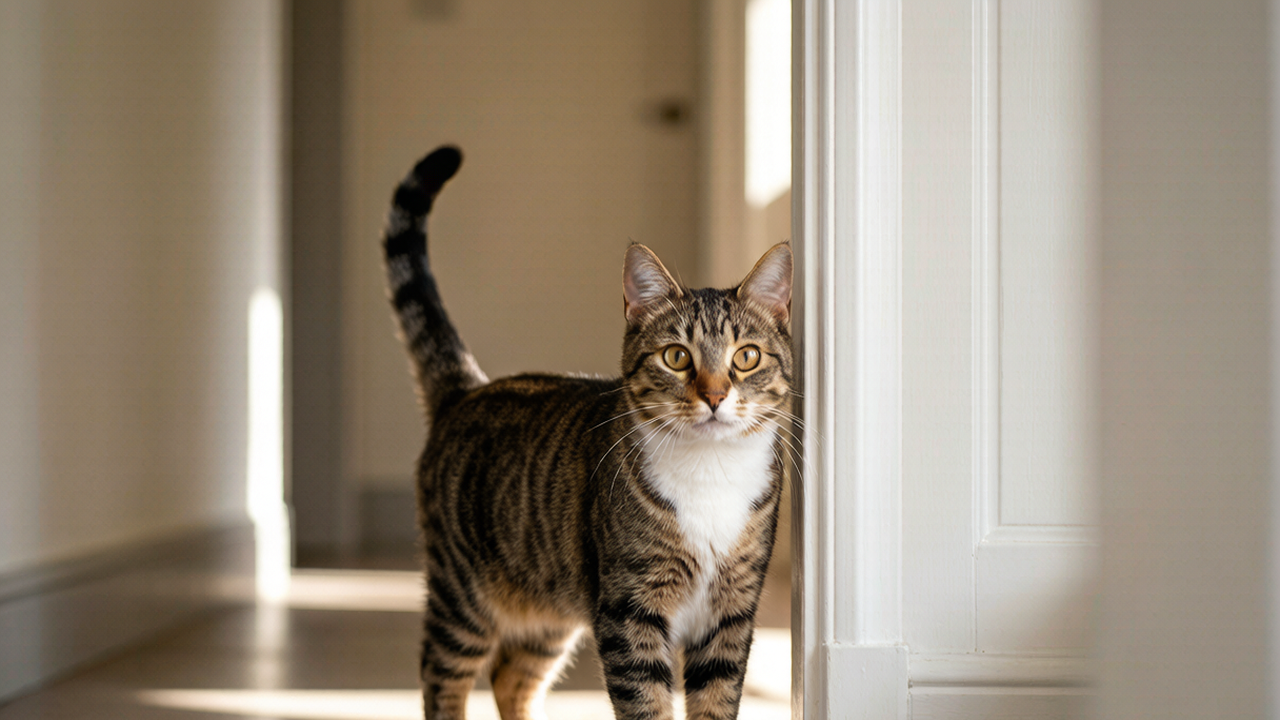
I smelled it before I saw it. That sharp, unmistakable ammonia punch that hits your nose and makes your brain go, "Oh no, not again." I followed my nose to the hallway, and there it was — a fresh, glistening trail running down the door frame of my bedroom. Little drops splattered on the baseboard. The wall next to it. Even the corner of my dresser.
Mochi, my 6-year-old tabby, was sitting in the hallway watching me with that perfectly blank cat expression — the one that says, "I have no idea what you're talking about, and frankly, I'm insulted you'd ask."
Here's the thing: Mochi is litter-box trained. Has been since she was 8 weeks old. She'd never had an accident in her life. So when I found that first spray mark, I did what most people do — I cleaned it up, checked her litter box (pristine, freshly scooped), and told myself it was a one-time fluke.
Three days later, she'd sprayed five different door frames, the side of the couch, and — somehow — a spot on the wall at exactly face height. This wasn't a fluke. This was a message. And I was about to spend the next several weeks learning a completely different language.
Spraying Is Not the Same as Peeing — and That Matters More Than You Think
I wish someone had told me this from the start, because I wasted a week troubleshooting the wrong problem: spraying and peeing are completely different behaviors.
When a cat pees outside the box, they squat. They leave a puddle on a horizontal surface — the floor, a rug, your laundry basket. It's usually a litter box issue, a medical problem, or both.
When a cat sprays, they stand. Their tail goes straight up and quivers at the tip. They back up to a vertical surface — a wall, a door frame, a piece of furniture — and release a small amount of urine, usually at nose height for another cat. It's not about needing to pee. It's about leaving a scent message.
The technical term is urine marking, and it's one of the most deeply wired behaviors in the feline brain. Cats in the wild use scent to define territory, signal reproductive status, and communicate with other cats without ever having to be in the same place at the same time. It's like leaving a sticky note that says, "I live here. This is mine. Move along."
When your indoor cat starts doing this on your door frames, they're not being spiteful or bad. They're responding to something that's made them feel insecure in their own territory.
The Two-Week Investigation That Cracked the Case
The first thing I did — and you should do this too — was take Mochi to the vet. Urinary tract infections, bladder crystals, and kidney issues can all cause a cat to associate the litter box with pain and start eliminating elsewhere. My vet ran a urinalysis and gave her a clean bill of health. So this was behavioral. Great. Now what?
I started playing detective. When did she spray? Where exactly? What had changed in our house recently?
Here's what I pieced together: Every spray mark was on a vertical surface facing a window or an exterior door. The hallway door frame faced the front door. The bedroom wall faced the side yard. The couch corner had a direct sightline to the sliding glass door. Mochi wasn't randomly decorating my house — she was strategically marking every entry point.
Then I looked out the sliding glass door and saw him. A big orange tomcat, lounging on my patio furniture like he owned the place. He'd been there every afternoon for who-knows-how-long, and Mochi had been watching him through the glass, her territory being casually invaded by a stranger she couldn't chase away.
That was the trigger. An outdoor cat visible from the windows, showing up daily, acting like my patio was his. Mochi couldn't get to him, so she did the next best thing — she marked every "border" of her territory to say, "This is mine. The cat outside does not live here."
The Three Things I Tried First (That Made Everything Worse)
Before I understood what was happening, I made some classic mistakes:
I punished her. Not physically — I'm not that person — but I would find a spray mark, say "Mochi, NO!" in my stern voice, and point at the wet spot. Mochi would run and hide under the bed. Here's what I didn't understand at the time: she had absolutely no idea what I was upset about. The spraying had happened hours ago. To her, I was just suddenly scary and unpredictable, which made her feel less secure in her territory. Which made the spraying worse. Punishing a cat for marking is like throwing gasoline on a campfire.
I cleaned with regular household spray. I was using a standard all-purpose cleaner — the kind with a nice lemon scent. Turns out, cats can smell urine proteins even after you've scrubbed, and household cleaners don't break those proteins down. They just mask the smell temporarily. The scent marker was still there at the molecular level, and Mochi kept refreshing it. Also, ammonia-based cleaners actually smell like cat urine to cats, so I was basically putting up a sign that said, "Please spray here again."
I closed the blinds and hoped for the best. Great idea in theory — block the visual trigger. But closing the blinds also took away Mochi's favorite sunbathing spot and her window perch. She got more stressed, not less. And the outdoor cat kept coming around, leaving his own scent markers on the patio. Mochi could still smell him even if she couldn't see him.
What Actually Stopped the Spraying: Five Things That Worked
It took about six weeks to fully resolve, but Mochi hasn't sprayed a single surface in over a year. Here's what actually made the difference:
1. Enzyme Cleaner — and LOTS of It
This was step zero, because nothing else matters if the scent signal is still there. I bought a gallon of enzymatic cleaner specifically formulated for cat urine (Nature's Miracle and Rocco & Roxie are the two I've used — both work). Enzymatic cleaners contain actual biological enzymes — protease, lipase, amylase — that digest the urine proteins at a molecular level and turn them into odorless water and carbon dioxide.
I soaked every sprayed surface. Not just a quick spray-and-wipe — I saturated each door frame, let it sit for 15 minutes, then blotted it up. I did this twice on every spot. Then I went hunting with a UV flashlight at night (cat urine glows under black light) to find spots I'd missed. There were four I hadn't even noticed — behind a plant stand, under the edge of a curtain, behind the TV stand.
You have to get every single one. If you miss one, your cat finds it, and the whole cycle starts over.
2. Window Film: Block the Trigger Without Losing the Light
This was the game-changer. Instead of closing the blinds, I applied frosted window film to the lower third of every window that faced the patio and the side yard. Mochi could still see the sky, still get her sunbeams, still watch birds in the trees — but she couldn't see ground-level cats anymore.
It cost about $15 for a roll and took 20 minutes to install with a spray bottle and a squeegee. If I'd known how effective this would be, I'd have done it on day one.
For the sliding glass door, I used a decorative film that let light through but blocked the lower half completely. Mochi kept her view of the bird feeder in the upper section. Everybody won.
3. Feliway Diffusers: The Chemical "Everything Is Fine" Signal
I was skeptical about pheromone diffusers. They sound like snake oil — plug it in, and your cat magically stops being anxious? But the science behind them is solid.
Cats have scent glands on their cheeks, chin, and around their whiskers. When they rub their face on furniture corners, door frames, and your legs, they're depositing facial pheromones — a chemical signal that means "I'm safe here. This is familiar. Everything is fine." Feliway Classic is a synthetic version of that exact pheromone.
I plugged one diffuser into the hallway where most of the spraying happened, and another in the living room near the sliding door. It took about three weeks before I noticed a difference — the instructions say 2 to 4 weeks, and they mean it — but once it kicked in, Mochi was visibly calmer. She stopped pacing near the windows. She started sleeping in her usual spots again.
One diffuser covers about 700 square feet. Don't plug it in behind furniture — the oil needs to circulate. And don't expect instant results. Let it work.
4. Making the Territory Feel Safe Again
The spraying was a symptom of territorial insecurity, so I needed to make Mochi feel like her home was actually hers. I added a tall cat tree near the sliding door, giving her an elevated perch she could own — cats feel safer when they can observe from height. I put a second litter box in the hallway, following the "N+1 rule" (one more box than the number of cats). And I moved her food bowl closer to the center of the house, away from any windows, so she didn't have to eat while watching for threats.
I also started a morning "patrol." After breakfast, I'd walk Mochi around the perimeter of the house — not literally, but I'd follow her while she sniffed every window sill and door frame. I'd rub a soft cloth on her cheek glands (right below her whiskers), then wipe that cloth on the spots she'd previously sprayed. This transferred her own calming pheromones onto those areas and helped overwrite the anxiety association.
5. Dealing with the Outdoor Cat
This was the part I couldn't fully control, but I did what I could. I stopped leaving anything on the patio that might attract the orange tom — no food, no water bowls, nothing that looked like a comfortable bed. I installed a motion-activated sprinkler at the edge of the patio. After getting sprayed twice, the orange cat found somewhere else to hang out.
If you're dealing with neighborhood cats and can't use a sprinkler, there are other options: motion-activated ultrasonic deterrents, citrus peels scattered along the perimeter (cats hate citrus), or simply asking your neighbors to keep their cats indoors. This last one is a long shot, obviously — outdoor cat owners tend to have strong feelings — but it's worth a polite conversation.
When It's Not a Neighborhood Cat
Not every spraying case is triggered by an outdoor cat. Other common triggers include:
Multi-cat household tension. If you have more than one cat and spraying starts suddenly, one cat may be blocking the other's access to resources — the litter box, the food bowl, the best sleeping spot. The solution isn't more discipline; it's more resources in more locations so nobody has to compete.
New furniture or renovations. Cats are creatures of habit who navigate the world largely by scent. When you bring in a new couch that doesn't smell like "home" or renovate a room that erases familiar scent markers, some cats respond by over-marking to re-establish territory. Give them time, rub familiar scents on new objects, and use a Feliway diffuser during transitions.
Changes in routine. A new work schedule, a new person moving in, a baby — any disruption to a cat's predictable daily rhythm can trigger insecurity. Maintaining consistent feeding times, play sessions, and quiet time helps enormously.
Medical issues. I cannot stress this enough — always, always rule out medical causes first. A cat in pain from a UTI or bladder crystals may spray because they associate the litter box with discomfort. If your cat is straining, crying, producing little urine, or has blood in their urine, skip the behavioral fixes and go straight to the vet.
The Bottom Line
It's been 14 months since Mochi last sprayed. The frosted window film is still on the sliding door. The Feliway diffuser is still plugged in — I replace the vial every month. The orange tom still wanders through the yard occasionally, but Mochi barely glances at him now. He's no longer a threat; he's just background noise.
What I learned through this whole ordeal is that cats don't spray to punish you or because they're "bad." They spray because something has made them feel unsafe in their own home, and they're trying to fix that the only way they know how. Every spray mark on a door frame is a cat shouting, "I need to feel like this place is mine again!"
Once you figure out what's making them feel insecure and address that root cause — not just the mess — the spraying almost always stops.
---
Has your cat ever started spraying out of nowhere? What ended up being the trigger in your case? I'd love to hear your detective stories in the comments — especially the ones where the culprit turned out to be something you never would have guessed.
🐾 Enjoyed This Article?
Save it for later, share with a fellow pet parent, or check out more tips on our homepage!